Advantages


Devices on a network are connected via different kinds of media.
For example, Wi-Fi and Bluetooth are both wireless communication technologies that use radio waves to connect devices without cables. However, Wi-Fi is designed for higher-speed data transfer over longer distances, commonly providing internet access for devices on a network. Bluetooth is designed for short-range communication with lower power consumption, typically connecting devices such as headphones, keyboards, and smart watches. Wi-Fi generally supports more bandwidth, while Bluetooth is more suitable for simple, low-energy device connections.
When we compare and contrast different transmission media, we often consider:
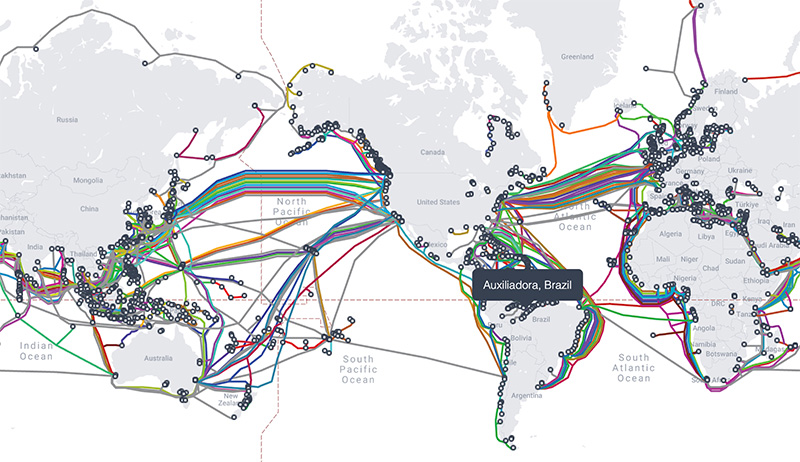
Another transmission media is optical fibre.
Click the map to see the world's submarine map.
Think about it. Fibre optic cable is used in remote, rugged public spaces.
It must be secure, offer a long range and not be susceptible to interference.
It is used to connect continents - it must have a high bandwidth.
Do a search for the Grace Hopper cable. How long is it?

One of the original transmission media before wireless and optical fibre was the humble twisted pair. Ethernet is the communication standard that commonly uses this cable.
It still remains the most commonly used cable in computer networking.
It's relatively cheap, when shielded not so susceptible to interference and it's more secure than wireless. Can you see why?
Make your own notes based on the information presented here.
Dig deeper into terms you are interested in.
Attempt as many exam style questions as you can!