Two Dimensional Arrays
Drivers for a racing team complete test circuits. They complete 3 test circuits every day from Monday to Friday. The team monitors how many times a driver uses the in-car radio to report a problem. This data is stored and analysed. Here is a sample table of data:
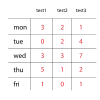
We can see that the data stored has the same data type - INTEGER. So, to help us manage the data we should use an array. We can also see that the data is easily understandable in a tabular format - we can imagine a table or a spreadsheet would be useful to store the data. In many computer programming languages, including Python, we can create a 2-dimensional array data structure to store this data.
2-dimensional arrays have a number of rows and a number of columns. In the above example, there are 5 rows and each row has 3 columns.
In Python, there are several ways to create and populate a 2-dimensional array. Let's populate a 2-dimensional array of 5 rows and 3 columns with zeroes like this:
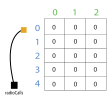
Technique 1
A 2D array is really just an array with lots of arrays inside it!
So, to create a 2D array in Python, we can do this:
radioCalls = [[0,0,0],[0,0,0],[0,0,0],[0,0,0],[0,0,0]]
To make it easier to visualize, we could change the layout of the code to:
radioCalls = [
[0,0,0],
[0,0,0],
[0,0,0],
[0,0,0],
[0,0,0]
]
Technique 2
Create a single array with 3 elements. Put a zero into each element.
arr = [0,0,0]
Next create an empty array.
twoDArr = []
Now, append 5 of the single arrays into the empty array - after all, a 2D array is just an array of arrays!
for i in range(5):
twoDArr.append(arr)
So how do we access each of the individual elements in a 2D array?
We can assign values to each element of the array as follows:
radioCalls[0][1] = 2;
radioCalls[0][2] = 1;
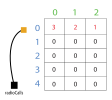
As you can see, the first index refers to the row and the second index refers to the column.
So, how can we process individual elements of an array?
A classic technique is to use a nested count-controlled loop. The outer loop processes the rows and the inner loop processes the columns:
for i in range(len(radioCalls)):#note len(radioCalls) tells us the number of rows
for j in range(len(radioCalls[i])):#note len(radioCalls[i]) tells us the number of columns in the row being processed
print(radioCalls[i][j])
Do you think you could write some code to total up all of the values stored in the 2-dimensional array?
Food For Thought
2-dimensional arrays are very useful and any Computer Scientist should know how to use them.
One important thing to consider is that a 2D array is just an array of 1D arrays!
tags
row column integer element count-controlled ascending index nested descending identifier datatype