Microprocessors and Registers
Songs by Blue Ducks and Blank & Kytt:
Cassette tape PSD by Mauricio Estrella
Microprocessor
A microprocessor is a central computer that controls a system. It performs tasks such as sending instructions to different parts of the system. It could be complex or extremely simple.
Imagine if the above cassette player was controlled by a remote control. The system would now need a microprocessor (or central processing unit, cpu) to receive the data and determine what needs to happen next.
For example, if the current state of the player is play and the microprocessor received rew, the microprocessor would understand that this is possible and instruct the player to rewind.
However, if the current state of the player is play and the microprocessor received switch, the microprocessor would understand that this cannot happen and nothing would happen.
But how would the microprocessor know the current state of each of the player's functions?
One way is to use a register.
Think of a register as a series of switches that can be either on or off. The combination of switches determines what the system will do.
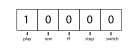
So, we can see that a register is a set of binary numbers which can be used to control a system. In the above example, a register storing 100002 means the cassette player is playing.
If the microprocessor sends an instruction 000102 to the register, the state of the system will be updated and the player will stop.
Each bit in the binary number stored in the register represents whether a part of the system is on or off.
Someone is playing with the remote control! Look at the following cycle. What is represented by the data stored in the register? Which one can never be allowed to happen?



Task 1

A washing machine has a door which can be open or closed.
It has a water input which can be either open or closed.
It has a spinner which can be either on or off.
It has a water level indicator which can either be on or off.
It has a weight sensor which can be either on (too heavy) or off (weight is ok).
There may be other functionality that you can think of.
Design a register for a washing machine. Identify what each bit in the register controls.
Task 2
Draw a washing cycle, represented by the data that your register will store during the cycle. eg perhaps first the door is open and the weight is fine. What would the contents of the register be in this situation? Then, the door closes and the water input starts. What would the contents of the register be? Continue the cycle until your socks are clean!.
Food For Thought
A register is a very basic part of a control system. It stores bits. Each bit controls a part of a system. 1 usually means "on" and 0 usually means "off". Sometimes, a certain combination of bits is never possible. For example, in the tape player register, we can never see 011002 because it can never be fast-forwarding and rewinding at the same time.



Homework
Think of a simple device that might rely on a register to help control it. Design the register.
Tags
big data cite consumer visualize quote target reputable bibliograpy predict static ubiquitous trends live