CPU
Your CPU is amazing
The Central Processing Unit in your computer is amazing. It completes extremely easy digital tasks. It completes billions of these easy tasks a second!
Move your mouse - your CPU will complete thousands of instructions to process the data from the input device (the mouse) and update the output device (the monitor) correctly.
It is in constant communication with primary computer memory - RAM - the special memory where a computer program is loaded when we run it.
Watch this video and answer the questions in the text file to get started on this topic:
In 1945, Jon Von Neumann designed a computer architecture that is still being used today and is termed the Fetch-Decode-Execute cycle. This means fetch an instruction from memory, decode the instruction, execute the instruction and then fetch the next instruction. The basic concept is illustrated as follows:
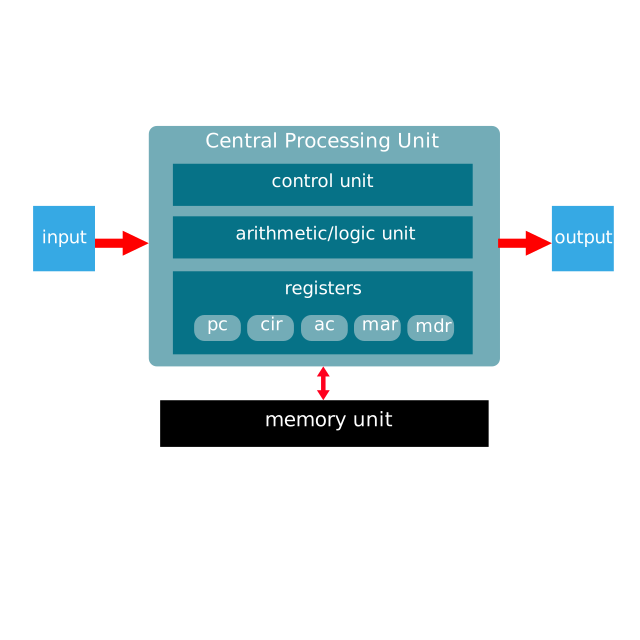
There are 2 main units:
Central Processing Unit
The Central Processing Unit (CPU) is responsible for executing instructions associated with a computer program.
It is sometimes called a microprocessor, chip or processor.
It contains the following units to help it perform its tasks:
The Control Unit
The control unit controls the operation of the computer’s Arithmetic/Logic Unit, memory and input/output devices, telling them how to respond to the program instructions it receives and interprets from the memory unit.
The control unit also provides the timing and control signals required by other computer components.
The Arithmetic/Logic Unit
The ALU performs mathematical operations (addition, subtraction etc) and logic operations using logical operators and, or and not.
Registers
Registers are high speed memory areas in the CPU. Data is passed into the registers for temporary storage before being processed.
Here is a description of the 5 main registers which exist in the CPU:
| acronym | register | purpose |
|---|---|---|
| CIR | Current Instruction Register | Contains the current instruction |
| PC | Program counter | Contains the address of the next instruction to be processed |
| AC | Accumulator | Where arithmetic and logical operation results are temporarily stored |
| MDR | Memory Data Register | Contains data that is being transferred to or from memory |
| MAR | Memory Address Register | Contains the memory location of data that needs to be accessed |
Memory Unit
The Memory Unit consists of Random Access Memory - primary storage. Unlike a Hard Disk Drive (HDD), it is directly connected to the CPU and can be accessed extremely quickly.
Think of RAM as a city of houses, where each house has a unique address and stores things. For a real house storage would be people, furniture etc but for RAM each address stores binary data.
Every time you open an application on your device, it is loaded into RAM and the CPU starts to fetch and execute instructions associated with the application.
Buses
Each component in the model needs to be connected to other components. To allow this, buses are used:
- the data bus carries the data
- the address bus carries the memory address
- the control bus carries the instructions
Food For Thought
Your cpu is truly amazing. It has a very high clock speed measured in bps (bits per second) meaning it can do many tasks very quickly. But it can only do one task at a time.



resources
Past Paper Questions
Tags
big data cite consumer visualize quote target reputable bibliograpy predict static ubiquitous trends live