artificial intelligence
Two very HOT TOPICS in the world of Computer Science are AI and Machine Learning? What are they? Aren't they the same thing?
Have a look at this video for an intro to these amazing topics.
Feel free to click the continue button and keep exploring!
We have seen that simple automated systems are quite intelligent. They can be programmed to compare input data from sensors with stored values and produce an output.
For example, an intruder alarm system will use a proximity sensor which measures distance. If an object (eg a human) comes within 10 meters of the sensor, then the microprocessor activates a light or an alarm.
Wouldn't it be great if a much more powerful system was capable of processing huge amounts of data and producing some kind of intelligent output that could help humans on planet Earth?
Even better, wouldn't it be great if such a system was capable of adapting itself depending on the data being processed, like humans do.
This unit will introduce the basic concepts of Artificial Intelligence. We will look at 2 categories of AI:
- Expert systems
- Machine learning
Expert systems
Expert systems are really just electronic boffins. They are capable of storing massive amounts of data and also rules about that data. They apply rules to the data to produce/infer a result.
One way to consider this concept is to understand something about declarative programming.
This brief video introduces the key concepts of expert systems:
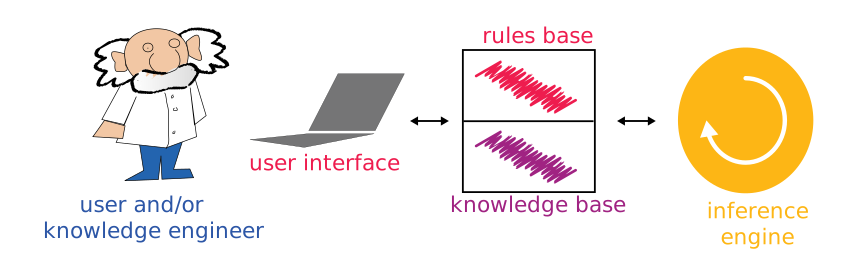
Here is an image which represent the ideas in the video:
Key points
Facts and rules are stored in a knowledge base. Some systems refer to a rules base (which is just part of the knowledge base!)
An inference engine interprets logic, facts and rules and produces a result. In the example in the video, the inference engine would interpret the following logic:
- wants_pet(Z, Y) IF person(Z) AND animal(Y)
Of course, the variables Z and Y will be replaced by values in order to determine a result.
An interface is required to input facts and rules.
In order for the expert system to produce useful results, it must be updated with new facts and rules as necessary.
An expert system acts as an advisor to human experts. It does not make final decisions based on the results provided by the inference engine - human experts make final decisions.
Machine learning
So expert systems process vast amounts of data and use logic to process the data and produce results.
What if an expert system could process information, learn from the results and also make its own decisions or predictions?
This describes the most recent and exciting evolution of artificial intelligence - machine learning.
This video gives a brief overview of the concept of machine learning:
Key points
Data is at the center of machine learning.
The machine can be trained with a set of sample data.
Think about browsing through Amazon or Lazada. Whenever you search for a specific item, you are training a machine to recognise things that you are interested in. The machine builds a model of your interests. Using this data model, it can then predict items that you may be interested in, even if you have never searched for them, and display them whenever you log into your account.
In other words, the machine is making predictions based on historical data - like humans do!
The more data available, the more accurate the prediction or conclusion.
This is an example of machine learning that you have probably experienced.
Task 1
Here is a real-world example of machine learning used in human cell analysis.
The machine is taught what healthy cells look like. Then, using image recognition, it is able to identify cells that may have issues.
Watch the video to get an idea of hoe machine learning can help scientists analyse cells in vast quantities very quickly.
Task 2
Let's train a machine!
We will train a machine to recognise some different objects and/or sounds and/or poses.
Click this link to access the teachable machine.
First we will gather samples to feed to the machine.
Then we will train the machine and let it build its data model.
Finally, we will test if the machine is able to make an accurate prediction.
So, expert systems are amazing at processing known data and making inferences/conclusions based on logical rules.
Machine learning goes a step further - machines can be taught to develop a data model and then use it to make predictions using data it may have never seen before.
Both expert systems and machine learning are branches of artificial intelligence and, over time, they are going to have a much creater impact on our lives on this earth.
Tags
expert system knowledge baseimage recognition interface predict knowledge engineerdata model inference engine train