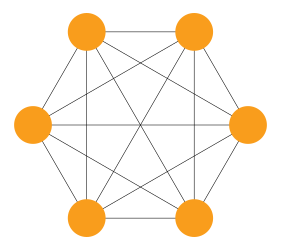
A Local Area Network (LAN) is a network of devices connected together by cables and/or wifi in a relatively small geographical area eg a school or an office building.
Their main aim is to communcate and share files.
In order to communicate on a network, devices need to follow a eg:
But what if the files that a device requires are on someone else's device and that device is turned off?
The solution to this is to have a special computer called a server which stores files and resources that other devices can request when needed.
These other devices can be considered clients, requesting information from the server.
Most servers have to be on 24 hours a day, 365 days a year!
Ethernet cable offers faster transmission than wifi. Also, physical objects like walls may cause interference with a wifi signal.
Also, it is hard to break into a cabled network unless you are in the building and devices don't have some kind of security measure eg password protection.
However, if you are within range of the wifi signal, you can attempt to join the network. A wireless network is considered less secure than a cabled network and, as the above image shows, connecting a wireless network to a wired network will make the wired network vulnerable to an attack!
Did you know that your device has a NIC?! This allows your device to join a network. It has a special address coded into it - it is unique and called the MAC (Media Access Control) address.
Your MAC address is needed so that when you send messages across the network, other devices know where the message came from.
A NIC can require a cable to attach it to a network or it can be a wireless NIC, for example in your smartphone!
So, the next time you connect to the Internet, don't forget that your NIC is a very NICE thing to have!
The Internet is global and would never work without agreed-upon protocols for the transmission, routing and receiving of data. Imagine if each sub-network on the Internet used a different set of rules for the sending and receiving of data?! It would be chaos!
The Internet is considered reliable because it is fault-tolerant - if one route breaks, another can be used.
So, enjoy it while this scenario remains!