Binary Digits
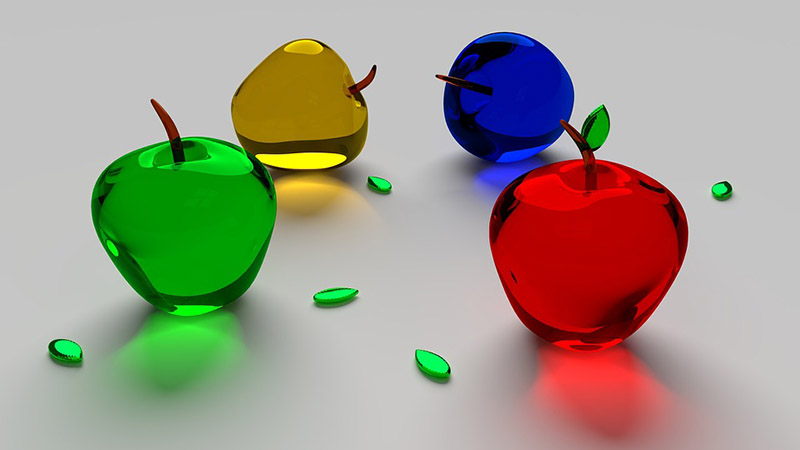
There are 4 apples on the table
aren't there?
Take a piece of paper and a pen. How many different ways can you express that there are 4 apples on the table?
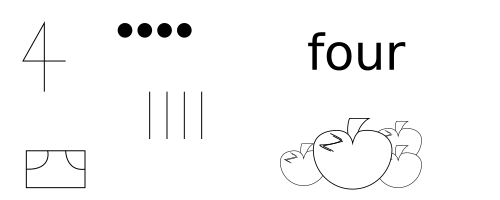
It doesn't really matter what symbols we use to express that there are 4 apples on the table. There are still 4 apples on the table!
We use the following 10 symbols to help us express the idea of quantity and numbers:
There are 10 symbols. This is known as a base-10 number system. There is a sequence as the numbers express bigger and bigger quantities:
Decimal Counter
So, humans enjoy a pretty logical number system. It is an example of abstraction. We look at the big, real world around us and we create symbols and ideas that help us to understand it in a human way.
But what about computers. They only deal with bits of information. Ones and zeros. It is a 2-state system. A binary system. A base-2 number system.
It is a 2-state system because computer memory is based on a device called a transistor. It can only handle 2 states: ON or OFF. This is also represented as TRUE or FALSE etc
There are only 2 symbols used in this number system:
Incredibly, combinations of these 2 symbols allow computers to represent anything digitally - an image, text, color, sound, video...
Here's a binary number! Computers understand this number perfectly!
I wonder if we can convert it to decimal (denary) so that we humans can understand it better?
Binary Counter
Observations
- In the decimal system, the first number tells us how many 1s there are; the second number tells us how many 10s there are; the third number tells us how many 100s there are, and so on.
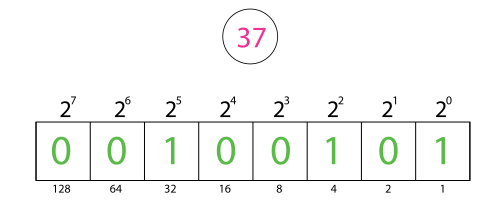
- In the binary system, the first number tells us how many decimal 1s are represented; the second number tells us how many decimal 2s are represented; the third number tells us how many decimal 4s are represented, and so on.
- We can use this knowledge to convert from binary to decimal.
- Converting from decimal to binary is equally straightforward. eg:
Task
Let's practice!
How good are you at converting binary to decimal and vice versa? Click the converter to play the super exciting binary-decimal converter game!

Food For Thought
The binary number system uses only ones and zeros. It is a base-2 system because there are only 2 possible states for any one bit of information. Us humans prefer decimal (sometimes called dernary) so it is useful to know how to convery from binary to dernary and vice versa.
convert